
What is liquid smoke doing inside Nigerian jollof rice?
The question posed in the title of this article is exactly the question I asked myself when I realized that "liquid smoke" substitute is now a thing for smokey jollof rice. Apparently, liquid smoke is a thing as per "flavoring" in the culinary world, but it has never been more rampantly used in Nigerian jollof rice like it is now. Well, at least from what I know, living in Nigeria and all the current Nigerian cuisine content storm sweeping social media platforms.

People don't seem surprised at how popular liquid smoke is, and the use is growing in popularity with Nigerian food content creators in the diaspora who promote cooking Nigerian smoked jollof rice without firewood. I can't really be dragging anyone craving smokey jollof and opting for liquid smoke, knowing how easily these abroad apartment smoke alarms easily trip off. At this point, I may have eaten smokey jollof made with liquid smoke without knowing because, from what I heard, one can't exactly tell the difference. Perhaps it should not or does not matter if it is real firewood or liquid smoke.

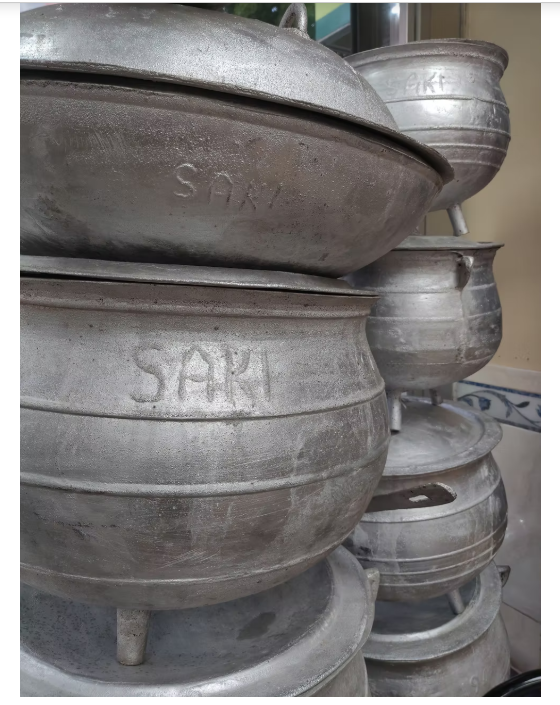
Growing up, I was accustomed to the Nigerian party jollof rice made with those heavy, huge aluminum pots with three-pointed extended stands from the round bottoms known as Koko Irin or Agede for sitting on hot brazing flames guided by 3 huge stones. Plus a spice of side talks and other items like moi-moi, chin-chin, fried meat, etc. on the menu cooking along. The rising smoke could literally suffocate you, leaving you with red eyes and a runny nose. It was cooking party rice with the real smoke.
"Liquid smoke aslo also known as wood vinegar, pyroligneous acid, smoke flavor, smoke flavouring, natural condensed smoke, is a water-soluble yellow to red liquid used as a flavoring to substitute for cooking with firewood. It can be used to flavor any meat or vegetable. It is available as pure condensed smoke from various types of wood and as derivative formulas containing additives" - Wikipedia.
Cooking with firewood is not even the easiest to start with, and the smoke from burning specific kinds of wood as firewood is known to cause serious discomfort, especially in enclosed spaces. According to the UNEP, an estimated 8 million premature deaths around the world every year are caused by air pollution, and of that number, more than 60% corresponds to pollution in residential environments. In Nigeria, about 98,000 women die every year due to the continuous use of firewood to prepare meals. A person who cooks breakfast, lunch, and dinner with firewood will have an equivalent health outcome as somebody who smoked between three and 20 packets of cigarettes.

In Nigeria, using firewood to cook is like a last resort for many families, and for some, it is the situation that determines the use of firewood. Say, for example, when people have big parties and the caterer has large batches of food to make, the use of firewood saves cost. Secondly, grilled and roasted food requires the use of firewood. Hence, firewood has always been used for cooking based on neccessity rather than luxury. So, if I said people who use liquid smoke are basically craving food made with firewood without the use of firewood, then I would be right because commercial bottled liquid smoke on our shelves could then be said to be a case of demand and supply.
Knowing the health concerns of the actual smoke from burning fossil fuel-induced firewood cooking, I have to wonder why anyone would be craving that same smoky-flavored food. And if at all, why not just make your firewood and cook it to get the natural smoky taste? Which brings me to the point where I ask how liquid smoke is now suddenly a thing associated with "smokey jollof rice"? At what point did it become okay to now opt for the use of artificially bottled smoke for our jollof rice, and what guarantees do the promoters of liquid smoke in jollof rice have that it will be the same in quality? You know, like, how "poundo yam" is still not the same as the real pounded yam but a near substitute? A case of if you know, you know (IFYKYK).

If we are now giving up smokey firewood jollof and embracing liquid smoke jollof rice, to what end? Whether liquid smoke contains potential carcinogens like Polycyclic Aromatic Hydrocarbons (PAHs) or not, the details of the risk it poses to human health remain complicated and may depend on various factors, including the amount consumed, the frequency of consumption, the factory ingredients, the food preparation technique, and the overall dietary context. So it is a case of "this may be bad, but we can't exactly be certain about how bad it is".
While some of us are running away from live firewood smoke for different reasons, the liquid smoke market in North America alone was valued at USD 116.0 million in 2025, driven by a growing demand for flavor enhancement in meat and poultry products. So you know, this is some serious business.
First it was jollof rice, a delicacy we all love to eat at parties and our homes; then it became "smokey" jollof rice, and that smokiness became a big deal, opening up a new demand for liquid smoke in jollof rice. Who knows, we may just find ourselves in a world where the real firewood jollof rice is being gradually phased into extinction as the liquid smoke offers the opportunity to satiate that smokey jollof rice craving without the usual hassle of burning firewood from the consumers' end.


Comments